
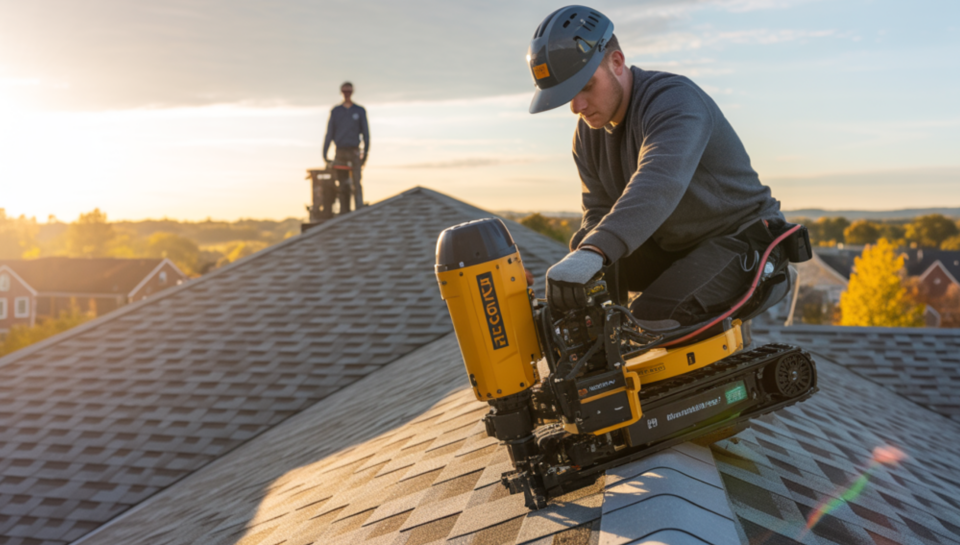
A decade ago, roofing was all grit and labor. Today, it’s on the cusp of a technical revolution—and multifamily operators need to start paying attention.
The shift is being driven by more than innovation for innovation’s sake. The labor pool is shrinking. Skilled roofers are aging out faster than new ones are entering the trade. According to the U.S. Bureau of Labor Statistics, the roofing industry is projected to grow just 1% over the next decade—far below demand. That labor squeeze isn’t theoretical. It’s already causing project delays, driving up costs, and forcing contractors to rethink the way they work.
Enter automation. Machines that can place, space, and secure shingles with near-perfect precision are no longer conceptual. They’re real, and they’re closer to market than most owners realize. As Melvin Scofield—a roofing project manager and early observer of these technologies—explains, “The gear exists today; we’re just shrinking it to fit a steep roof.”
What makes this shift possible is a convergence of fields. Car manufacturers have used robotic nailers for years. That hardware now adapts to roofing. The process is simple but effective: a laser line is calibrated by a human. The robot follows it, picks up shingles, nails them in place, and scans every nail head for accuracy. If one misses, it corrects the error on the spot. Every placement is logged—with timestamp, GPS location, and visual confirmation—providing instant documentation for warranties and future inspections.
The financial implications are significant. On a mid-sized clubhouse roof, Scofield has seen robotic assistance cut labor days by 40%. In one pilot, human crews alone required 10 days at $2,600 per day—totaling $26,000. With a single robot and recalibrated workflow, the project finished in six days, with labor costs dropping to $15,600. Add $4,000 for robot rental, and the total still came in 25% lower. Multiply that savings across a 15-building property, and it becomes a six-figure margin swing.
This isn’t just about money. Insurers like automation because it lowers risk. Fewer people on ladders means fewer fall claims. Fewer repetitive motion injuries. Less downtime. The underwriting math changes. So does the speed of completion—faster installs reduce exposure to weather, allow crews to move on sooner, and help new builds or renovations open on schedule.
But the robots don’t replace people. They refocus them. Roofers aren’t being pushed out—they’re being pushed up. Humans still handle edge work, flashing, and gutter tie-ins. They set up the job, calibrate the tech, and solve for what machines can’t handle—yet. What disappears are the repetitive rows of nail-after-nail monotony. The dullest tasks go machine. The skilled labor gets elevated.
For property teams, the call to action is simple: don’t wait until your vendor shows up with a robot—start asking about them now. Ask your roofing partners what pilots they’ve observed or participated in. Add a line in your RFPs that says, “Please list any automation used and how it affects warranty or schedule.” Budget for a pilot test. Even a single-building trial can help your team understand how the workflow changes.
Because make no mistake—this shift is happening. The first contractors who adopt at scale will set the pace. The rest will scramble to catch up. And owners who understand the tech early will be the ones negotiating better timelines, safer jobsites, and smarter capital deployment.
Melvin Scofield isn’t a futurist. He’s a working pro calling the curve before it hits. And the curve is clear: roofing is going autonomous. You can either prepare now—or pay more later.