
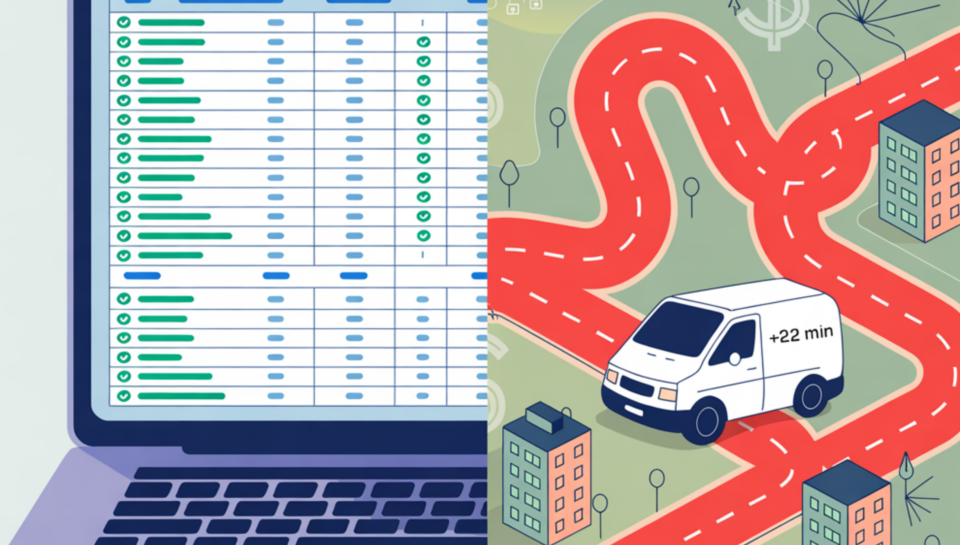
Centralized service hubs look powerful on a spreadsheet. A single mobile crew, one inventory room, uniform service-request standards—surely that means lower payroll and tighter quality control. Yet portfolios that rush to a one-size model often learn a hard truth: the miles between assets can swallow the savings. What looks efficient during budgeting turns into windshield time once dispatch begins. A technician who drives twenty minutes to swap a GFCI outlet has already doubled the labor cost a resident-facing on-site tech would have logged—an expense that chips straight at NOI.
Tool access magnifies the problem. When specialty parts and ladders live at a hub, a field visit can stall for want of a three-dollar cartridge. The tech returns to base, the clock keeps running, and the resident waits in frustration. Spread that detour across a city-wide portfolio and the supposed economies of scale fade into contractor invoices and overtime payroll, further eroding NOI. Detachment adds another hidden cost. Residents build trust with familiar faces who know the quirks of each stack. When service becomes a rotating cast of strangers on GPS dispatch, the perceived drop in care shows up in online reviews and, ultimately, renewal rates.
Centralization can succeed, but only under narrow conditions. Properties must sit in a tight cluster to keep drive time low. A maintenance-workflow platform has to route service requests by both skill and distance so the EPA-licensed HVAC tech takes the heat-pump call three blocks away—not across town. Specialized tasks—commercial boiler calibration, high-voltage electrical work—travel well because they happen infrequently and justify deeper expertise. Clear workflows, stocked satellite lockers, and guaranteed communication loops back to leasing and resident apps are non-negotiable.
Many operators now favor a hybrid model. Each community keeps a resident-facing generalist for make-readies, inspections, and urgent calls, while a roving specialty pod handles deep mechanical work across a limited metro. The blend preserves local accountability, shares expertise, and protects response times without bloating payroll. Before redrawing org charts, smart owners map travel radii, audit parts duplication, and pilot one specialty hub. If the metrics hold—and resident scores stay steady—expansion becomes a data-backed move, not an efficiency myth.
Centralization is a tool, not a silver bullet. When geography, workflow discipline, and tech infrastructure align, it can sharpen performance. When they don’t, the model can erode both resident trust and NOI. Balancing local presence with strategic resource sharing remains the surest path to consistent, cost-effective service.
What the Data—and the Doors—Tell Us
– Travel drag bites fast. Time-and-motion analysis shows every extra 15 minutes of windshield time adds roughly $8–$10 in direct labor to a service request. Across a 3,000-unit metro portfolio, an added 20 minutes per call can bleed more than $180,000 in annual labor cost—directly lowering NOI.
– Vendor dependence offsets payroll savings. Portfolios that shift more than 20 percent of service requests to outside vendors after centralizing report higher total maintenance spend because premium trip charges outpace any payroll reduction.
– Access control can make or break the model. Nearly three out of four U.S. communities still rely on metal keys for unit entry. In a hub structure, misplaced rings or wrong-site drives account for up to 30 percent of arrival delays. Mobile techs need universal, time-stamped smart-lock credentials; without them, a $2 spare key turns into a two-hour detour—another silent hit to NOI.
Centralization delivers only when the math works and the entry doors open on the first attempt. Address both, and the hub concept moves from theory to measurable gain. Ignore either, and efficiency slips away—one mile, one tool, and one misplaced key at a time.